Like the quarry found last year, this one is north of the Old City.  From the Jerusalem Post:

For the second time in the past year, archeologists have uncovered a Second Temple Period quarry whose stones were used to build the Western Wall, the Israel Antiquities Authority announced Monday. The latest archeological discovery was made in the city’s Sanhedria neighborhood, located about two kilometers from the Old City of Jerusalem. The quarry was uncovered during a routine "salvage excavation" carried out by the state-run archeological body over the last several months ahead of the construction of a private house in the religious neighborhood. The quarry is believed to be one of those used to build the Jerusalem holy site because the size of the stones match those at the Western Wall. "Most of the stones that were found at the site are similar in size to the smallest stones that are currently visible in the Western Wall, and therefore we assume that the stones from this quarry were used to build these structures," said Dr. Gerald Finkielsztejn, director of the excavation. The stones were dated by pottery found at the site, he added. "This is a rather regular quarry except that there are really big stones," Finkielsztejn said. The largest of the stones found at the quarry measures 0.69 x 0.94 x 1.65 m, while some of the stones were apparently ready for extraction but were left in place. The quarry was probably abandoned at the time of the Great Revolt against the Romans in 66-70 CE, he said.
Share:

The Jerusalem Post is reporting that stones in the Western Wall are crumbling.  A little background:

The “Western Wall” is a 60-meter section of a 480-meter long western compound wall of Herod’s Temple Mount.  This portion of the wall has been revered by Jewish people for centuries as a place of prayer because the temple does not exist and access to the temple court areas has been forbidden (either by rabbis or Muslim rulers or both).

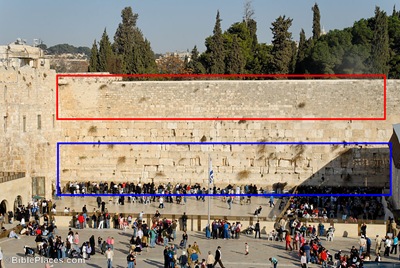
Three distinct sections of construction are visible in the prayer portion of the Western Wall today. 

The lowest seven courses (blue box in photo below) were constructed by King Herod in the 1st century B.C.  The wall above this was destroyed, probably mostly in the Roman destruction of A.D. 70.  Arab rulers in the 7th-8th centuries rebuilt part of the wall and these stones are visible above the Herodian stones (between blue and red boxes). 

In the 19th century, there were problems with Muslims throwing objects and trash from the Temple Mount down on Jewish worshipers at the wall and so the British-Jewish philanthropist Moses Montefiore donated so that the wall could be built to a higher level.  It is these stones (in red box) that are the subject of this JPost story.  Read the article to learn more about whether the rabbis will permit restoration or not.

Western Wall, tb122006991
The crumbling stones are the smallest and most recent stones (red box). 
The original Herodian stones are in the blue box.
Update (4/17): Leen Ritmeyer has a lengthy explanation of the situation on his blog.
Share:

The Canadian Jewish News has an article about the archaeologist who found Iron Age period remains on the Temple Mount a few months ago

Yuval Baruch, left, made archeological history in October 2007 when he uncovered pottery artifacts on the site of Jerusalem’s Temple Mount. They are considered to be the first physical evidence of human activity during the time of King Solomon’s Temple (the First Jewish Temple). Baruch, who is Jerusalem’s district archeologist at the Israel Antiquities Authority, speaking at the Berney Theatre here, outlined his world-famous discovery as part of a lecture series put on by the Canadian Friends of the Hebrew University.

And the interesting part:

“I was not supposed to be left there alone, as the Waqf always has someone present when Israeli archeologists are on the site. It was in the evening after 8 p.m., and by chance the Arab electrical workers left me and a member of my staff for about 15 minutes while they went to pray. When I was alone in that brief time, I found the pottery shards among dust near the bedrock level,” he says.

And what he found:

Baruch’s findings include animal bones; ceramic bowl rims, bases and body shards; the base of a juglet used to pour oil; the handle of a small juglet; and the rim of a storage jar. In addition, a piece of a whitewashed, handmade object was found. It may have been used to decorate a larger object or may have been the leg of an animal figurine. The finds are dated from eight-to six-century BCE.

And I bet you can’t believe this:

“The reaction of the Muslim authority [the Waqf] was to ignore the finds,” he adds, which he says was not surprising since over the years the Waqf has tried to undermine Jewish historical ties to the site. “The Waqf’s official position is that there was never a Jewish Temple on the Temple Mount, he says.”

You can read the full story here.

Share:

For thousands of years, the Jewish people have celebrated the Passover sacrifice, but without a *sacrifice.*  It’s one thing when you’re an oppressed minority in Europe, but it’s another when you’re the ruling majority in your own land.  One would think that this would be the cause of great discussion, but it seems that the intervening years have muted the felt need for a sacrifice for most. 

But not all.  From Arutz-7:

The demonstration of the Paschal sacrifice is part of a study day scheduled to take place on Sunday, the First of Nissan (April 6), at the Kotel Yeshiva in the Jewish Quarter of Jerusalem’s Old City. The study day is a joint project of the Temple Institute, the Sanhedrin and the King David Museum. It was originally planned to take place one week later, but the organizers decided to dedicate it to the memory of the eight yeshiva boys murdered in Jerusalem recently, and to hold it on the 30th day after their death.
The study day is to include a public sacrifice which is being termed a “general rehearsal” for the actual Pesach sacrifice on the Temple Mount, a ritual prescribed by the Torah but currently forbidden by the Israel government and courts.
Glick told Ynet Monday that according to Jewish law, abstaining from performing the sacrifice is an extremely serious offense, comparable in its severity to avoiding a brit (circumcision ceremony) for one’s newborn boy. He explained that although Jewish law forbids Jews in an impure state (which all Jews are in as long as the Temple rites are not renewed) from entering the Temple area, an exception is made for public sacrifices like the Pesach sacrifice. 
The Temple movement recently sent a formal request to Prime Minister Ehud Olmert and Minister of Public Security Avi Dichter, to allow them to conduct the sacrifice on the Temple Mount. “Making the Paschal sacrifice is part of the religious freedom which is a basic human right and a cornerstone of democracy,” they wrote.  Glick said, however, that the organizers “have no intention of trying to ascend to the Mount without permission from the police….
Another animal rights activist, Etti Altman, said the sacrifice has no place in an “enlightened country” like Israel and quoted from the ancient Sifri biblical commentary which says: “As God is called ‘compassionate,’ so should you be compassionate.”

The full story is here.

Share:

I’ve mentioned the on-going sifting operation of the Temple Mount debris before (here and here), but I haven’t noted a relatively new video about the project.  The video is about 5 minutes long and gives a good overview of what they are doing and why.  If you’re interested in participating in the “excavation,” but don’t want to go alone, there’s a group going with the Associates of Biblical Research this summer.

Share:

The Jerusalem Post has a couple of recent articles related to Jerusalem and archaeology.
Police stop Islamic work on Temple Mount – The police won’t stop the Muslims from digging up the ground but they’ll stop them from replacing tiles.  I wouldn’t call this progress.

Digging too deep? – A report on the political aspects of the excavations in the City of David.

As always, don’t believe everything you read.

Share: